MANILA - President Rodrigo Duterte said on Friday his war on drugs had cut back the supply to "very low" levels and thanked China for supporting his crackdown, but swore repeatedly at ally the United States for criticizing it.
Duterte said his bloody campaign against drugs had successfully reduced the narcotics flow, but conceded there were signs that criminals had now turned to kidnapping, another problem he planned to tackle.
"There is a very low supply of drugs now. But, there is a shift to kidnapping by these idiots," he said during a televised speech. "This is a new game, so be careful. Give me time to talk to God."
The crime-busting former mayor of the once lawless Davao City said last week he had spoken to God and promised him he would no longer use bad language.
But his vow has not held long. On Friday, he got angry again at former colonial power Washington for its concerns about alleged summary killings and contrasted its stance with that of China, which has funded a huge drugs rehabilitation center.
"Now who helped? China," he said. "America, what did they say? 'Duterte, stop the extrajudicial killings. We hold you responsible'," he said.
Watch His Full Speech On Integrated Bar of the Philippines’ (IBP) Regional Convention (Speech) 11/4/2016
"I said: 'You can go to hell. You're all shit. You look at us Filipinos like dogs... You're all really sons of bitches because you violated our dignity.'"
As a provincial outsider in May's presidential election, Duterte used his brashness and profanity to enhance his public appeal. Dubbed "the punisher" and "Duterte Harry", he was elected by a big margin.
That was aided by the promise of a drugs war, which has killed over 2,300 people in four months.
Duterte on Friday homed in on Human Rights Watch, which he said was attacking him to justify a $100 million, 10-year grant philanthropist George Soros promised it six years ago.
"This Human Rights Watch of New York, that belongs to Soros. Soros was the financier. That's him. It's his grant," he said.
President Rodrigo Duterte and Philanthropist George Soros
"They have funding money. They will really attack to justify. They chose me... they're pounding on me. That is fine, editorials every day. I can swallow that."
Duterte's relentless assaults on Washington have baffled the country's biggest ally, but do not appear to have resonated among Filipinos and the local business community, which has expressed concern.
A recent opinion poll of 1,200 Filipinos showed they had far greater trust in the United States than they did in China, which Duterte has been praising and courting strongly.
Duterte invited his countrymen to protest if they disagreed with him.
"If you think America will be good for you, if you want to be a (U.S.) territory ... if it is to your personal interest, go ahead and join the demonstration," he said.
"And maybe you can convince me to leave the presidency. But at least I leave without being treated like a pig by the Americans."
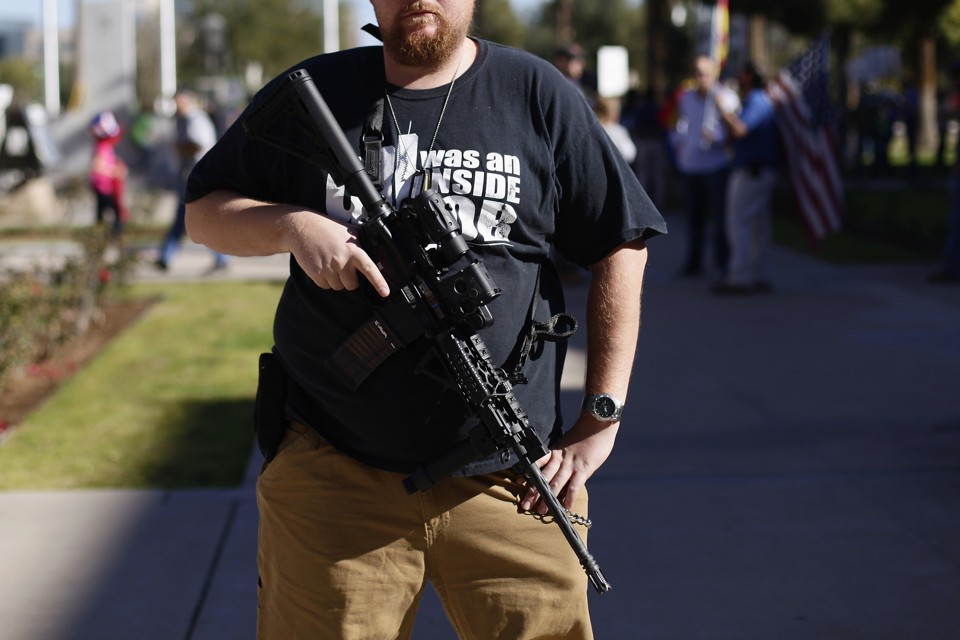
The post below shows that not all the guns used by Americans where made in U.S.A., and only proved that there are many manufacturers of guns in the world with low prices but still have the quality and power.
(This post consist of 2 page articles)
I have written and copied this post from around the internet (a trusted website - you can see the source after the post) because I want to show to my fellow Filipinos including madame De Lima (who really fears or concerned about the US government cancellation of selling assault riffles to PNP - Read here) that Philippine government can buy guns that is also used by Americans.
In May 2000, Representatives Nancy Pelosi, Pete Stark, and Carolyn McCarthy wrote a letter to their House counterparts urging them to deny China a far-reaching and highly-coveted trade status called Permanent Normal Trade Relations. In their warning, the three Democrats didn’t mention the potentially damaging economic or political ramifications of such a relationship with China or even invoke the country’s infamous human-rights record. Instead, they focused on one specific issue: semi-automatic weapons.
From 1987 until 1994, some 42 percent of all rifles imported into the United States had come from China. The representatives noted that an embargo had been imposed in 1994 because, in just a few years, China “had exported almost one million Chinese rifles to the United States—more than made by all U.S. manufacturers combined in 1992.” Conferring this new trade designation, they argued, would effectively unravel the embargo and allow assault rifles like the SKS semi-automatic to become cheaply available again. “What made them attractive was their power and inexpensive price, only $55.95,” they wrote of the SKS, noting its popularity among neo-Nazis, gangs, and white supremacists. The letter concluded, “Don't give China the power to decide gun policy in the United States.” The bill was signed into law that October.
The US State Department’s reported decision to stop the sale of assault rifles to the Philippine National Police (PNP) was a consequence of the Duterte administration’s “incomprehensible and ridiculous policy shift," Senator Leila De Lima said on Tuesday.
De Lima, a staunch critic of President Rodrigo Duterte, criticized the government’s shift in foreign policy, saying the Philippines’ “independent positioning” was “hollow and all bluster.”
“We cannot go on telling the US to leave us alone just because we don’t want it prying into our human rights records and EJKs (extrajudicial killings). Sooner or later, something has to give,” De Lima said.
“This is just the start of what we will be reaping from the US as result of the isolationist whirlwind this administration has sown and continue to sow out of an incomprehensible and ridiculous policy shift to anti-Americanism and pro-totalitarian Chinese hegemony in Asia,” she added.
De Lima said the Philippines’ independent foreign policy would lead to isolation and hostility not only to the US but also its allies in the region like Japan, Australia, and South Korea.
“The question is, how does this deliberate strategy to isolate us from our friends fit a comprehensive foreign policy shift that would somehow benefit us as a nation?” De Lima said.
Duterte has repeatedly said that the Philippines, during his administration, would pursue an independent foreign policy.
Senator Panfilo Lacson, for his part, said the Philippines did not stand to lose anything if the US would stop the rifle sale.
“There are tens of other countries that manufacture better and probably cheaper assault rifles than the US,” Lacson said.
De Lima also said the move of the State Department “should have been expected” because of the rise in number of EJKs amid the administration’s war on drugs.
“The Duterte administration saw this coming and of course was most probably indifferent to its consequences as its social media support groups and fake news sites will now drum this up as an opportunity to be independent of the US, and its support weapons supplies and technology,” De Lima said.
A Reuters report said the planned sale of some 26,000 assault rifles was halted following opposition from Senator Ben Cardin over concerns about human rights violations in the Philippines. —NB, GMA News
American Concern About Human Rights? How About Watching this Video
Malaysian Prime Minister Najib Razak visits China, barely a week of Philippine President Rodrigo Duterte’s visit.
Malaysian Prime Minister Najib Razak’s week-long visit to China will start October 31. Will it mark a turning point for Malaysian foreign policy, similar to the one recently made by President of the Philippines Rodrigo Duterte?
US policy in the South China Sea received a powerful blow during Duterte’s momentous visit to Beijing, when he officially announced his country’s “separation” from the US and “realignment” in China’s “ideological flow.”
Najib Razak’s visit to China is expected to cement defense deals, as well as in economics.
The text of a speech to be delivered by Malaysian Defence Minister Hishammuddin Hussein was posted on Facebook last week saying his government would will sign a contract to purchase naval patrol vessels from China during the trip. The post was later removed.
Over the first three months of this year, Chinese investment in manufacturing in Malaysia reached 1.5 billion ringgit (HK$2.7 billion), making it the largest foreign investor in the sector.
Chinese firms have also secured major deals in Malaysia, including a US$7.3 billion port deal in the city of Malacca. China is widely expected to sign a contract to build Singapore to Malaysia high-speed rail line.
Ties between the United States and Malaysia have been strained since the US Department of Justice launched lawsuits linked to money laundering investigations into Najib’s pet project, 1MDB. Further deals and investment with China could put a further strain on ties with Washington.
This visible ASEAN pivot to the BRICS is sending shockwaves to the Khazarians in the US and UK, who are trying their best to force these ASEAN leaders to follow on their self-serving diktats.
This visible ASEAN pivot to the BRICS Alliance is sending shockwaves to the Khazarians in the US and UK. The CIA is in fact activating its asset, ex-president Fidel V. Ramos, to force Duterte to sign the 2015 Paris Agreement on Climate Change,
Duterte’s rebuff of climate treaty akin to ‘shooting himself in the mouth’ – FVR
In his own bluntly-worded manner, former President Fidel V. Ramos said that President Rodrigo Duterte was “full of S….T” if he thought his diatribes against the Philippines’ allies and the 2015 Paris Agreement on Climate Change Agreement was his God-given destiny, given that his rejection of the climate agreement was akin to him and the entire country “shooting [themselves] in the mouth”.
… Ramos argued further that failure to ratify the Paris Agreement would limit the Philippines’ participation in the 22nd session of the Conference of the Parties (COP 22) in Marrakesh to mere observers, and we would thus be unable to advance the interests of the country.
Ratification, however, will “enable us to secure more investments towards our climate goals and gain access to the financial, technological, and capacity-building support to be provided to parties of the Agreement.”
Ramos concluded by calling on the president to approve the Paris Agreement “forthwith”, and “certify it for Senate ratification to promote our country’s interests and fight for climate justice.”
This is just one of a series of stupid, unwarranted interference on the policies of the incumbent Duterte government, which border on utter hypocrisy considering Ramos’ failed “trickle down” economics, and massive privatization of critical government utilities, all of which did not uplift the life of the majority in the Philippines.
Leftist groups have also criticized Ramos for his economic reforms such as privatization, deregulation and trade liberalization, claiming that the economic growth posted during his presidency was “artificial.” They blamed him for the slowdown of the Philippine economy during the 1997 East Asian financial crisis. The sale of 40% of Petron to Aramco is specifically criticized for resulting in the loss of the government’s effective leverage on domestic oil prices.
… In 1998, the Union for Socialist Ideas and Action told a left-wing Australian organization that Ramos hesitantly admitted that contrary to his government’s earlier claim, the economic fundamentals of the country may actually be unsound. His admission came following the discovery of a secret memorandum issued by the National Economic Development Authority director-general urging the president to tell the Filipinos the truth about the state of the economy and that they ought to prepare for worse. According to former University of the Philippines president Francisco Nemenzo, Ramos “has done nothing to reverse or slow down the implementation” of the harmful IMF-imposed structural reforms.
While Malaysia’s Mahathir was very vocal against Soros’ currency attack on the ASEAN economy, Fidel Ramos was so silent about the whole sordid affair in 1997.
Ramos’ series of unsolicited advice started just after Duterte announced his “separation from United States” and for joining China in its “ideological flow.”
Let it be remembered that Ramos was given a consultancy position at the Carlyle Group when his 6-year term as president ended in 1998. This consultancy position and that of this presidency served as a lifelong reward for his cooperation in the toppling of the late president Ferdinand E. Marcos.
“Despite earnest grassroots nationalist opposition over the past several decades, the Philippines remains a neo-colony of the United States, economically and military bound to Washington, and hopelessly addicted to foreign capital.
The US has a huge economic stake in the Philippines, which is central as a military and intelligence base, as well as a source of energy, raw materials, land, and cheap labor. It was no surprise that securing the Philippines was the focus of the first US post-Afghanistan intervention in the so-called “war on terrorism.”
In his book Endless Enemies, the late Jonathan Kwitny described the Philippines as “the Zaire of Asia,” and “the one Asian country where we (the United States) have engaged in covert political activity, and sometimes fighting, and where things have gone pretty much our way. Every anti-guerrilla campaign has been victorious, and every election, real or rigged, has produced the winner the US government desired.”
… Former President Fidel V. Ramos is Arroyo’s “special envoy for international opportunities.” Despite his denials about the importance of his role, Ramos functions essentially as the country’s co-president.
He is also a direct agent of the Bush oligarchy.
Ramos is a senior advisor of the Carlyle Group and the head of Carlyle’s Asian advisory board. Its directors include former US president George Herbert Walker Bush, former US secretary of state James Baker, current US secretary of state Colin Powell, former SEC chairman Arthur Levitt, former UK Prime Minister John Major, and former South Korean Prime Minister Park Tae-Joon.
Carlyle’s client list has included the likes of the bin Laden family and George Soros (a major player involved in the so-called Asian economic crisis of the late 1990s). Saudi prince Alwaleed Bin Talal has been one of Carlyle’s major investors. Its chairman is former Reagan administration defense secretary Frank Carlucci. Carlyle has major stakes in Taiwan, Singapore, South Korea, Japan and China, which was recently admitted into the World Trade Organization.”
Ramos also spearheaded the 2nd Yellow Revolution to topple the more popular President Joseph E. Estrada in 2001. He is expected to lead again the toppling of the incumbent president Rodrigo Duterte, not only for the latter’s pivot to BRICS, but to preserve the Abu Sayyaf terror network which is now suffering heavy casualties amidst heightened military operations in Sulu and Basilan.
Stratfor revealed that the US Armed Forces built a military base on the southern Philippine island of Basilan. Road-building projects, passed on as “civic action,” started the process of reestablishing a U.S. military base as part of America’s power projection and “forward basing” in Southeast Asia, the Texas-based think tank said.
Said base is where CIA operatives are sending their instructions and intel regarding the specific movements of AFP soldiers against their terrorist assets, i.e. Abu Sayyaf militants, on the ground. This explains why the Abu Sayyaf terrorists have always defeated the AFP cauldrons set up prior to Duterte’s presidency.
BRICS + ASEAN vs. Khazarian Mafia
There is now a strong possibility that Russia, like China, will not sit idly by on this golden opportunity to establish stronger economic and military alliances with the ASEAN now that the leaders of these countries have expressed, in concrete terms, their willingness to sever ties with the Nazionist Khazarian criminal syndicate holding up in the US and EU corporate governments.
Proof of the Philippine-Malaysia coordination on the ASEAN efforts to pivot to the BRICS Alliance is the recent courtesy call of the Malaysian Deputy Prime Minister and Speaker of the Lower House of the Parliament of Malaysia, to President Duterte, a day prior to Malaysian Prime Minister’s visit to China.
Courtesy Call Of the Malaysian Deputy Prime Minister
After the US presidential elections, the ASEAN region is where the next battle for geopolitical supremacy between BRICS virtual leader, Vladimir Putin, and Rothschild henchman, George Soros, will be waged next.
In order to deal with Soros, Malaysian officials need to give Vladimir Putin a call.
George Soros wants to create color revolution in Southeast Asia
by Jonas E. Alexis
George Soros has again shown that Jim W. Dean was right all along. Soros, Dean says, “refuses to die and join his victims.” Soros, Dean moves on to declare, has been involved in the “the age-old pump-and-dump stock manipulation scam” for quite a while.
As we have argued elsewhere, Soros was involved in destroying the Russian economy in the 1990s. But he has created other covert activities as well. He was behind the Black Lives Matter movement. He wants to flood Europe with so-called refugees from virtually all over the Middle East while remaining silent about US officials supporting terrorist organs in Syria. In short, Soros still wants to move and shake the world.
Soros has recently turned his attention to Southeast Asia. He wants to taste economic blood in that region. He has been in that part of the world before. And government officials know him pretty well.
Prime Minister Mahathir Mohamad of Malaysia declared back in 1997 that for people like Soros, “wealth must come from impoverishing others, from taking what others have in order to enrich themselves. Their weapon is their wealth against the poverty of others.”[1] The New York Times reported then:
“Mr. Mahathir specifically blamed Mr. Soros for orchestrating Malaysia’s economic crisis—he told the assembled bankers and economists that Mr. Soros’s ilk had to be stopped.”
Mahathir said: “I am saying that currency trading is unnecessary, unproductive and totally immoral. It should be stopped. It should be made illegal. We don’t need currency trading.”
Mahathir was trying to articulate that rapacious usury is antithetical to the moral order and is therefore to be avoided. He has witnessed what usury, through “crony capitalism,” has done and how it precipitated the economic crisis in much of Asia, most specifically in South Korea and the Philippines. The same “currency” has brought down economic progress in places like Thailand and Indonesia, where was a drastic decline in income. One scholar noted:
“The enormity of the shock is captured by the fact that in the worst-affected countries real GDP growth has turned abruptly from over 7 per cent per annum to negative. In Thailand growth fell from 6 per cent in 1996 to almost zero in 1997, with all the decline concentrated in the second half of that year, and has fallen by at least a further 5 per cent in 1998. In Indonesia the corresponding swing is from 8 per cent growth up to the third quarter of 1997 to an absolute decline of 15 per cent in 1998…
“These huge aggregate income shifts were the result of a financial crisis reflected in precipitous currency devaluations and falls in equity prices. Currencies depreciated by up to 80 per cent in the worst case (the Indonesian rupiah) while equity and other asset prices fell by 50 per cent or more in the worst-affected countries.
“The key factor behind this currency and stock market collapse was a massive reversal of foreign capital flows. It has been estimated that for Indonesia, the Republic of Korea, Thailand, Malaysia and the Philippines net private inflows dropped from US$ 93 billion to 12 billion – a swing of 11 per cent of GDP between the end of 1996 and the end of 1997.”
Many countries in Asia were basically following capitalism by that time, and it was no accident that they had a huge debacle by 1997.[5] Mahathir, in that sense, was trying provide a response to that debacle. Soros didn’t like what Mahathir said because Soros is a capitalist and wanted to rip people in Southeast Asia off their labor. He fired back at Mahathir by saying:
“Dr. Mahathir’s suggestion yesterday to ban currency trading is so inappropriate that it does not deserve serious consideration. Interfering with the convertibility of capital at a moment like this is a recipe for disaster. Dr. Mahathir is a menace to his own country.”
Mahathir seemed to have learned his lesson. By 2003, he created a storm of controversy by saying that “The Jews rule the world by proxy. They get others to fight and die for them.”
Some have said that Mahathir was promoting violence against Jews, but that itself is false. If a person says that the Japanese bombed Pearl Harbor, it does not necessitate the illogical idea that every single Japanese person is responsible for Pearl Harbor at all. Mahathir was making a general claim, and many Jews, including Henry Makow, agreed with him. Elias Davidsson of Jerusalem concurred as well. He said:
“As a Jew myself (but opposed to Zionism) I need no encouragement from Malaysain PM Mahathir Mohammed to observe what should be obvious to the blatant eye: Namely that Jews effectively rule US foreign policy and thus determine to a great extent the conductof most countries…
“So it is with the proposition that Jews control the world. Surely the do not control every single action; surely it does not mean that every Jew participates in the ‘control.’ But for all practical purposes the proposition holds.
“Mahathir has neither asked to discriminate against Jews, let along to kill Jews. It is shameful to equate him to the Hitlerites.”
Mahathir added elsewhere that “a U.S. dominated IMF was ‘trying to change the Asian system.” Obviously that “U.S. dominated IMF” was in concert with capitalism, which has been refined in the twenty-first century by people like Milton Friedman.
But Mahathir probably wouldn’t expect Soros to come back to Southeast Asia for round two. It has been reported that Soros is looking for a “color revolution” through his Open Society Foundation in Malaysia because he seems to think that there is a lack of “constitutional democracy.” Like Rodrigo Duterte, Malaysian Prime Minster Najib Razak has recently been trying to build an alliance with China:
“Malaysian Prime Minster Najib Razak heads to China next week to build closer ties and seek investment, which may further dent US aims in Southeast Asia after a push by President Rodrigo Duterte of the Philippines to bolster China ties.”
Obviously this is not good news for New World Order agents at all. It gets worse: “Both Malaysia and the Philippines have long been in dispute with China over the South China Sea. However, Kuala Lumpur may follow in the footsteps of Manila, seeking to ease tensions with Beijing in exchange for economic benefits.”
Soros again does not like that, and this might be one reason why he declared that “There is no Business like the Revolutions Business.’” Mathew Maavak of Risk Foresight at Universiti Teknologi Malaysia (UTM) comments:
“NGOs and the West-friendly media constitute a major subsidiary of the global social revolutions enterprise. Together, they seek out, identify and amplify public discontent in nations not aligned to the United States.
“Such US-engineered activisms have never led to more equitable societies; rather they have engendered endless bloodshed and global terrorism. To the agitprop entrepreneur, the returns on revolutionary investments are immense.
“A wealthy hedge fund manager can short a targeted market before executing a pre-planned ‘revolution.’ The resultant stock market and currency meltdown would provide self-evidentiary ‘proof’ to an anxious public, exerting more pressure on the government of the day to either capitulate or concede to ‘popular demands’ that are actually drafted abroad, likely by the IMF!”
Maavak, like other experts in Asia, are well aware that Soros was behind the economic crisis in 1997. He writes,
“The entire region was in turmoil, and the name of George Soros featured prominently in this sordid saga. The ‘Reformasi’ [protest] movement led by sacked [Malaysian] Deputy Prime Minister Anwar Ibrahim — who had close to ties to Washington hawks — failed to topple the government of the day.”
Perhaps Malaysia needs to do what China and Russia did: they need to kick Soros out of for good. Or perhaps they need to give Vladimir Putin a call and ask him how he did it. But what if China, Malaysia, the Philippines, and Russia end up forging an alliance, since they all realize that they have a common enemy? Would that be good news for the New World Order?
I guess US Deputy Secretary of Defense Bob Work has good reason to say: ““Our adversaries [Russia], quite frankly, are pursuing enhanced human operations and it scares the crap out of us.”[16]
Aside from the fiat monetary scam and bloodsoaked petrodollar, another significant source of funds for the Nazionist Khazarian Mafia is the “healthcare” industry which registered a whopping $3.09 trillion in 2014, and is projected to soar to $3.57 trillion in 2017, in the US alone. We believe that this is just a conservative figure.
We can all help the revolution by avoiding all Khazarian pharmaceutical drugs, defeat any viral attack and scaremongering, like the Zika virus, easily by knowing how to build our own comprehensive antiviral system. Find more about how we can kill three birds with one stone, right here.
President Rodrigo Duterte appointed Ramos as special envoy in July to thaw Philippines-China relations after years of tension over claims in the South China Sea.
"The moment the President came back from China from a successful state visit I resigned as special envoy to China because the officials have taken over," Ramos told GMA News.
"I've done my job to... break the ice and to help restore the ties of goodwill and friendship," he added in an interview after paying tribute to the departed Thai King Bhumibol Adulyadej at the Thai Embassy in Makati City.
Ramos made the disclosure after writing several opinion columns criticizing Duterte.
In a column published by Manila Bullentin early this month, Ramos on occasion of Duterte's 100th day in office said the President did not hit the ground running during the first months of his administration.
He said the government was "stuck in unending controversies about extra-judicial killings of drug suspects and in his ability at using cuss-words and insults instead of civilized language."
Ramos, a graduate of the United States Military Academy at West Point, also chided Duterte for declaring a foreign policy independent from the US.
Ramos said countries have become interconnected and that Duterte's "independent foreign policy" may not be the way to go.
Duterte, shortly after his electoral victory, credited Ramos for convincing him to run for President.
"I still consider myself a part of the Duterte team whether they like it or not. But I am free to give friendly advice and that is part of our democratic culture," Ramos said.
The former President said his newspaper commentaries were meant to help solve the country's problems.
"You must consider me an older brother of the big, big, big Filipino family because of my long service in government," Ramos said.
"I must be considered by everybody, including the present President as an older brother of the family," he added.
"Those who wish the big Filipino family peace, sustainable development, progress and a place of respect and even admiration in the family of nations, must get together and look for the best solutions to the problems," Ramos said.
"That is my attitude," he added.
Panatag Shoal, fishing rights
Duterte and Chinese President Xi Jinping in October had bilateral talks and reportedly discussed the overlapping claims in the South China Sea, particularly in the Scarborough Shoal.
National Security Adviser Hermogenes Esperon said Duterte raised the issue of the Filipino's traditional fishing rights at the Panatag Shoal with Xi.
“There was no expressed agreement but it seems like the traditional rights of our fishermen are being respected,” Esperon said in a phone interview with reporters.
Filipino fishermen were already able to sail and fish at the Panatag Shoal days after Duterte returned from his trip to China.
Esperon said no agreement was reached during the bilateral talks when Duterte raised the ruling of the Permanent Court of Arbitration upholding the country's exclusive economic zone and the Filipinos' traditional fishing rights.
Xi, in turn, reportedly raised China's historical claims.
“Basta nag-usap ang dalawang presidente at hindi natapos yun dahil ang position ng China is may historical rights sila dun, tayo may historical rights tayo at saka nanalo tayo sa Arbitral Tribunal, yun ang position ni Digong (Duterte’s nickname)," Esperon said.
"Hindi sila nagtagal doon (sa issue) dahil marami silang ibang pag-uusapan so walang agreement,” he added. —NB, GMA News
Some Filipino fishermen from Subic, Zambales are now able to fish at Scarborough Shoal (Panatag Shoal), a report said on Friday.
A "News To Go" report quoted a fisherman as saying that his comrades who ventured off waters have reported via radio that Chinese vessels no longer sent them away.
Fishermen there consider this good news, after more than four years of being unable to enter the territory due to the presence of the Chinese Coast Guard, the report said.
While Malacañang maintained that the territorial dispute between the Philippines and China will not be discussed in depth, President Rodrigo Duterte said he spoke to Chinese President Xi Jinping about Panatag Shoal issues in a closed-door meeting during his state visit in China.
The two countries released a joint statement last Friday, saying they agreed not to use force in settling the disputes, and that this should not get in the way of the other aspects of their relations.
In July, the Permanent Court of Arbitration in The Hague in the Netherlands ruled in favor of the Philippines in a case it filed against China, calling the Panatag Shoal a "common fishing ground."
President Duterte doesn't dilute the ruling of tribunals, but he said that there will be a time that and now is not the time. The most important is the result his actions to small fishermen.
Watch Pinoy Fishermen Claim They Can Fish Again At WestPH Freely
Senator Leila de Lima accused President Rodrigo Duterte of attempting to appease China by allegedly “trying to dilute” an international tribunal's ruling on the West Philippine Sea dispute between the two countries.
In a media briefing Thursday, De Lima criticized Duterte for allegedly diminishing the gains of the Philippines’ victory against China in the South China Sea, parts of which Manila refers to as the West Philippine Sea.
“Huwag natin waldasin ‘yung gains na nakuha natin, ‘yung victory, ‘yung triumph natin in that monumental case na nabilib sa atin ang buong mundo na ginawa natin ‘yun at nanalo tayo dun,” De Lima said.
“Tayo pa mismo ang nagmamaliit doon sa significance ng ruling na ‘yan just to appease China,” she added.
After his state visit to Beijing last week, Duterte said he “will not impose now” on finding a resolution to the Philippines’ territorial dispute with China.
"I will not insist now. I will not impose now. I will not go to war now. I will not waste the lives of my soldiers," Duterte said.
In contrast, De Lima said the government should instead be asserting the ruling released by the Permanent Court of Arbitration last July.
“Dapat nasa period dapat tayo ng enforcement or assertion of the ruling pero ginagawa ba natin? Hindi,” she said.
“Parang baliktad ang ginagawa ngayon ng Pangulo. Siya mismo ang nangunguna in trying to dilute if not weaken the import and significance of that ruling,” De Lima added.
De Lima said if former President Benigno Aquino III was still the chief executive, he would now be soliciting the support of the international community.
Tthe Philippines had filed the arbitration case against China during Aquino's term.
“Kung si president PNoy pa rin ang pangulo, yan ang ginagawa niya ngayon to enforce, to try to enforce, try to seek and solicit the support of the international cmmunity to put the pressure on China to recognize the ruling of the arbitral tribunal,” she said.
De Lima reminded Duterte of the possible “consequences” of his statements concerning the Philippines’ territorial claims.
“He may be held accountable under the Constitution,” De Lima said as she agreed with the opinion of Supreme Court Associate Justice Antonio Carpio that giving up the country’s sovereignty over the Panatag (Scarborough) Shoal could be a ground to impeach Duterte.
De Lima said Filipino fishermen do not need the authority of China to fish in the disputed Panatag Shoal, which is located 124 nautical miles west of Zambales.
“Hindi yan pag-aari ng China, hindi rin ng Pilipinas pero may common rights to fish and utilize, exploit the resources in the Scarborough Shoal,” she said. — VVP, GMA News
Blog Author View:
Kung ganyan ang pananaw mo ma'am De Lima, bakit hindi mo subukang sumama dun sa mga mangingisda sa WestPH na naranasang bombahin ng mas malalaking barko ng Tsina. Isa pa, walang batayan ang sinasabi mong dinilute o pinawalang bisa ni President Duterte ang ruling o yung pag kapanalo natin (napakalayo naman ng pagkaunawa mo).
Malinaw na sinabi niya, hindi ito ang tamang panahon. Dahil kung ipipilit mo yan ngayon, digmaan lang ang paraan para makuha natin ng agresibo yang isla na yan at yun ata talaga ang gusto mong mangyari madam?
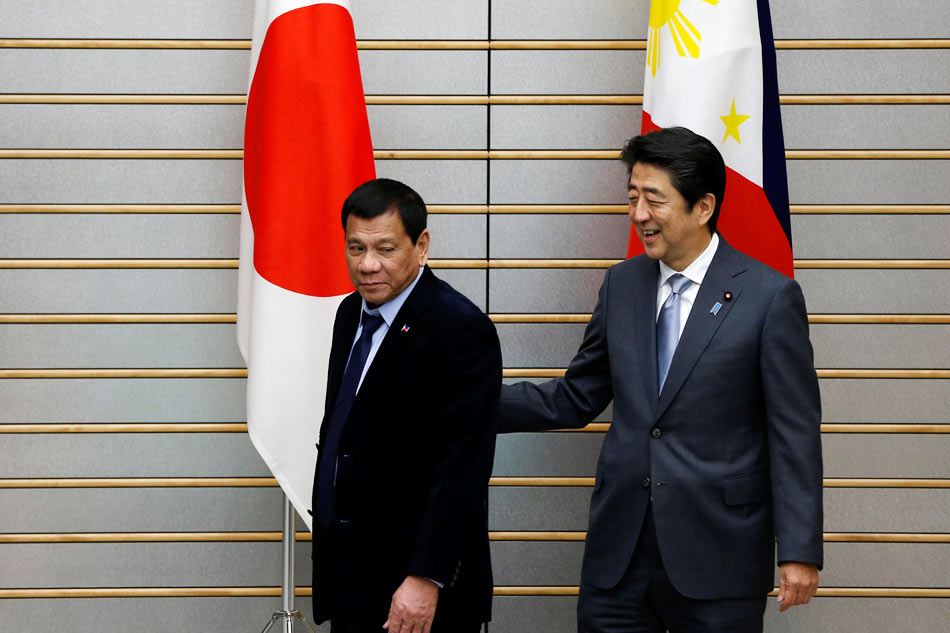
Philippine President Rodrigo Duterte sought to assure Japan on Wednesday that his high-profile visit to China last week was about economics, not security, and vowed to stand on Tokyo's side over the disputed South China Sea when the time came.
Earlier in the day, Duterte reiterated his harsh words for long-time ally Washington, saying he might end defense treaties.
The volatile Philippine leader's visit to Japan comes amid jitters about his foreign policy goals after weeks of verbal attacks on ally the United States and overtures toward China.
Duterte last week announced in China his "separation" from the United States, but then insisted ties were not being severed and that he was merely pursuing an independent foreign policy.
His perplexing comments pose a headache for Japanese Prime Minister Shinzo Abe, who has tightened ties with Washington while building closer security relations with Manila and other Southeast Asian countries as a counter-weight to a rising China.
"You know I went to China for a visit. And I would like to assure you that all there was, was economics. We did not talk about arms. We avoided talking about alliances," he told an audience of Japanese businessmen.
Duterte, speaking through a Japanese interpreter at the start of his talks with Abe, later said he would stand on Japan's side in the contentious matter of the South China Sea.
Describing Japan as a "special friend who is closer than a brother", Duterte said after the meeting that Manila would work closely with Japan on regional issues of common concern and uphold the values of democracy, the rule of law and peaceful settlement of disputes including the South China Sea.
Reading from a statement, he added: "Today we have taken steps to ensure that our ties remain vibrant and will gain greater strength in the years to come."
INDEPENDENT FOREIGN POLICY
Both Tokyo and Washington have grown worried that the commitment under Duterte's predecessor, Benigno Aquino, to stand up to China in the South China Sea is under threat, although Japan has no direct territorial row with Beijing there.
Japan has a separate dispute with China over tiny, uninhabited isles in the East China Sea, and has been keen to stress the importance of the rule of law.
Abe, for his part, said he welcomed Duterte's efforts to improve Manila's ties with Beijing and - noting the South China Sea issue was one of international interest - said the two leaders had agreed on the importance of settling maritime disputes peacefully.
Aquino angered China by lodging a case with an arbitration court in the Hague challenging the legitimacy of Beijing's maritime claims in the resource-rich sea. The court's ruling in July emphatically favored Manila but was rejected by China, which has warned Washington and Tokyo to stay out of the feud.
Duterte earlier told an audience of Japanese business executives he did not pick quarrels with his neighbors, but had tough words for Washington.
"I have declared that I will pursue an independent foreign policy. I want, maybe in the next two years, my country free of the presence of foreign military troops. I want them out," he said.
"And if I have to revise or abrogate agreements, executive agreements, this shall be the last maneuver, war games between the United States and the Philippines military."
China claims almost the entire South China Sea, through which about $5 trillion worth of trade passes every year. Brunei, Malaysia, the Philippines, Taiwan and Vietnam also have claims on the sea, believed to have rich oil and gas deposits.
Duterte has threatened to abrogate defense agreements with the United States several times but has yet to take any concrete action beyond cancelling some minor navy patrol exercises.
In a pattern already becoming familiar, Duterte's foreign minister, Perfecto Yasay, tried to soothe concerns raised by the president's remarks. He told a news conference that Manila would respect treaty obligations as long as mutual interests converged.
Japan and the Philippines also signed notes on two yen loan projects worth up to 21.4 billion yen ($205 million), including one to build two patrol boats for the Philippine Coast Guard to boost its capacity for search and rescue and law enforcement.
To be sure, an offical axis between China, Russia and a nation that until recently was a core US ally in the Pacific Rim - whose loss would be a huge slap in the face of Obama and whoever replaced him as president - would be music to Putin's ears, which is why just minutes after Philippine President Duterte announced his stunning separation from the US, Russia’s ambassador to the country promptly said Moscow is ready to provide assistance to and fully cooperate with Manila.
"Formulate your wish list. What kind of assistance do you expect from Russia and we will be ready to sit down with you and discuss what can and should be done,” Russian Ambassador Igor Khovaev told GMA News on Friday. He then went on to state that Russia is open to working with the Philippines in “any area, any field of possible cooperation.”
The ambassador assured the news outlet that Moscow would not “interfere with the domestic affairs of a sovereign state,” and that the “true Russia” is much different than the one portrayed in Hollywood films. Khovaev added that the Philippines and Russia “deserve to know each other much, much better.”
The aggresive, if diplomatic brown nosing continued, when the ambassador also said that Duterte impressed Russian Prime Minister Dmitry Medvedev during a meeting in Laos last month, and that Moscow supports the leader’s fight against illegal drugs and criminality. In short, he said everything that Durterte wanted to hear just to make sure the Chinese-Russian-Philippino axis takes hold.
For its part, the Philippines’ budget minister announced that his country is open to all forms of assistance, but will choose what is in the “best interest of the country,” Reuters reported.
This could also include yet another U-turn, and prompt return to the safety of being a US puppet.
Which is why on Friday, the Philippines’ trade minister, Ramon Lopez, told CNN that the leader “wasn’t talking about separation” from the United States.
Although Duterte explicitly stated that the Philippines would be separating from the US economically, Lopez said that “in terms of economic [ties], we are not stopping trade, investment with America. The president specifically mentioned his desire to strengthen further the ties with China and the ASEAN region, which we have been trading with for centuries.”
He explained that the Philippines was just “breaking being too much dependent on one side…but we definitely won’t stop the trade and investment activities with the West, specifically the US.”
Related Video: Watch Arrival from state visits to Brunei Darussalam and People's Republic of China
President Rodrigo Duterte on Sunday said that he insisted during his meeting with Chinese officials, including President Xi Jinping, that the Scarborough Shoal belongs to the Philippines.
"Ang China ang sabi nila amin 'yan. Sabi ko amin man din 'yan," Duterte said in a speech during his visit to calamity-stricken Tuguegarao City in Cagayan.
In his speech in Isabela, Duterte said both he and Xi held their ground in claiming Scarborough Shoal, with the Chinese leader citing China's supposed historical claim while the Philippine leader presented the award of the Permanent Court of Arbitration.
“Alam ko may problema tayong dalawang bansa dahil diyan sa [South] China Sea na inangkin ninyo na inyong lahat. Kami naman ay nanalo at sinabi na sa Pilipinas yan. But anyway, ang problema, ang sabi niya amin talaga ito historically at hindi kami bibigay dito. Sabi ko, lalo na kami, kasi kami ang nanalo sa korte,” Duterte said.
But Duterte avoided a confrontation with Xi, saying both leaders will discuss the territorial dispute in the future.
“Sabi niya na we can resolve this case peacefully nang walang away, walang dugo and it will take time. Okay lang, sabi ko, basta balang araw we will continue to talk and one day in the future pag-usapan talaga natin. Di naman pwede na hayaan na lang natin ito nakabitay,” he said.
“Sabi ko ito yung award namin, sabi ko balang araw, hindi tayo lalabas sa dokumentong ito sang-ayon na kami ang nanalo diyan sa pagmamamay-ari. Pero I will not insist now. I will not impose now. I will not go to war now. I will not waste the lives of my soldiers,” Duterte added.
While both sides insisted ownership of the shoal, he said China has agreed to allow Filipino fishermen to enter the territory, which the Philippines considers part of the territory of Masinloc town in Zambales province.
"Ang pagkaalam ko pinaalis na rin niya [Xi] iyong mga Chinese na fishermen para wala nang makita diyan. Iyon ang pinag-usapan namin," he said, but added that he was not sure if the Chinese will fulfill their promise.
Duterte said that during his meeting with Chinese officials, he proposed that both countries keep off the shoal's inner lagoon, the spawning ground of the shoal that also serves as a safe haven for fishermen from tropical cyclones.
"Ako na mismo ang nagsabi kung makabalik tayo sa Scarborough, bilang may-ari, sila rin naman nagsabi na [sila ang] may-ari, ako na mismo magsabi na huwag kayong mangisda diyan [inner lagoon]," he said.
In his speech, Duterte told the city's typhoon-affected residents about China's granting of $24 billion (over P1 trillion) in soft loans to the Philippines.
He said he will use the fund to improve the country's agriculture industry and put up small "sari-sari" stores that will serve as financing centers for the poor communities.
Watch President Duterte on Ceremonial Distribution of ESA and Relief Goods 10/23/2016
The $24-billion investment and credit line pledges that the Philippine government secured from China earlier this week were a display of “greater confidence” in the future economic relationship of the two countries, according to Trade Secretary Ramon Lopez.
In a text message to reporters, Lopez said that the renewed friendships in this part of the world have opened huge opportunities for Philippines’ trade and investment in China and Asean market of over 1.9 billion people.
Subic-Clark railway project by Bases Conversion and Development Authority (BCDA) and China Harbour Engineering Co.
Bonifacio Global City-Ninoy Aquino International Airport Segment of Metro Manila Bus Rapid Transit-EDSA project by BCDA and China Road and Bridge Corp.
BCDA-China Fortune Land Real Estate project (memorandum of understanding);
Safe and smart city projects for BCDA by BCDA and Huawei Technologies
Transportation and logistics infrastructure at Sangley Point by Cavitex Holdings, International Container Terminal Services Inc. and China Harbour Engineering
Joint venture agreement of Jimei Group of China and Expedition Construction Corp. for infrastructure projects
North Negros biomass and South Negros biomass project by North Negros Biopower and Wuxi Huaguang Electric Power Engineering
Jin Jiang hotel room capacity expansion from 1,000 to 2,000 by Double Dragon Properties and Hotel of Asia Inc.
Joint development project on renewable energy by Columbus Capitana and China CAMC Engineering
New Generation Steel Manufacturing Plant by Mannage Resources and SIIC Shanghai International Trade HK;
Joint venture on steel plants by Global Ferronickel and Baiyin International
Renewable energy projects by Xinjiang TBEA Sunoasis
Davao coastline and port development project by Mega Harbor Port and Development and China Harbour Engineering;
Manila Harbour Center reclamation by R-II Builders Inc. and China Harbour Engineering
Cebu International and Bulk Terminal project by Mega Harbour Port and CCCC Dredging Company
Cabling manufacturing facilities by MVP Global Infrastructure Group and Suli Grp Ltd.
Manila EDSA Bus Transportation program by Phil State Group and Yangtse Motor group and Minmetals International
Hybrid rice production by SL Agritech and Jiangsu Hongqi Seed Inc.
Bus manufacturing facility by Zhuhai Bus and Coach Co.
Banana plantation project by AVLB Asia Pacific and Shanghai Xinwo Agriculture Development Co.
300MW Pulangi-5 Hydro Project by Greenergy Co. and Power China Guizhou Engineering Corp.
Pasig River, Marikina River and Manggahan Floodway bridges construction project by Zonar Construct and SinoHydro;
Ambal Simuay sub-river basin flood control project by One Whitebeach Land Development and Sino Hydro;
Nationwide island provinces link bridges by Zonarsystems and PowerChina Sino Hydro; and
Railway project (study) by MVP Global Infrastructure group and China Railway Engineering Corp.
These investment agreements are expected to generate 2 million jobs over the next five years.
Meanwhile, financing facilities worth a total of $9 billion would come from the China State ($6 billion) and Bank of China ($3 billion), Lopez said.
“We will maintain relations with our other partners but we would revive the stronger integration with our neighbors. We share centuries of trading, similar cultures and a better understanding of our region,” he said.
“For China alone, they continue to be the Philippines’ second major trading partner with $17 billion value in total trade. Our exports to China were $6 billion in 2015 but this still has high growth potential as we establish better relations and considering China’s total imports was around $2 trillion in 2015. Another promising area again is investment from China. Their investment to the Philippines dropped to only $32 million in 2015. But China’s total outward investments was around $130 billion in 2015,” the trade chief said.
Watch Meeting & Signing Ceremony at the Bank of China 10/21/2016
BEIJING — President Rodrigo Duterte on Wednesday declared that he was breaking the Philippines' military and economic alliance with the United States, the country's longtime ally.
Duterte made the remark before Chinese government officials and business leaders who attended the Philippines-China Trade and Investment Forum.
With the "separation" from the US, Duterte said he would now be relying on the Chinese officials and businessmen.
"I announce my separation from the United States both in the military but economics also. So please you have another problem of economics in my country," Duterte said.
"I have separated from them so I will be dependent on you for a long time but don't worry we will also help," he added.
Duterte said he also planned to visit Russia and firm up ties with Moscow.
"I realign myself in your ideological flow and maybe I will also go to Russia to talk to Putin. There are three of us against the world. China, Philippines, Russia," Duterte said.
Duterte over the past months stepped up his anti-US rhetoric after US officials, including US President Barack Obama expressed concern over the alleged extrajudicial killings blamed on his war on drugs.
The President also announced that October's joint military exercises with the US would be the last under his term.
Worth $13.5 Billion Deals Would Be Signed
Duterte made his comments in China, where he is visiting with at least 200 business people to pave the way for what he calls a new commercial alliance as relations with longtime ally US deteriorate.
His trade secretary, Ramon Lopez, said $13.5 billion in deals would be signed.
Duterte's efforts to engage China, months after a tribunal ruling in the Hague over South China Sea disputes in favor of the Philippines, marks a reversal in foreign policy since the 71-year-old former mayor took office on June 30.
China has pulled out all the stops to welcome Duterte, including a marching band complete with batton-twirling band master at his official welcoming ceremony outside the Great Hall of the People, which most leaders do not get.
President Xi Jinping, meeting Duterte earlier in the day, called the visit a "milestone" in ties.
Xi told Duterte that China and the Philippines were brothers and they could "appropriately handle disputes", though he did not mention the South China Sea in remarks made in front of reporters.
"I hope we can follow the wishes of the people and use this visit as an opportunity to push China-Philippines relations back on a friendly footing and fully improve things," Xi said.
Following their meeting, during which Duterte said relations with China had entered a new "springtime", Chinese vice foreign minister Liu Zhenmin said the South China Sea issue was not the sum total of relations.
"The two sides agreed that they will do what they agreed five years ago, that is to pursue bilateral dialogue and consultation in seeking a proper settlement of the South China Sea issue," Liu said.
China claims most of the energy-rich South China Sea through which about $5 trillion in ship-borne trade passes every year. Neighbors Brunei, Malaysia, the Philippines, Taiwan and Vietnam also have claims.
In 2012, China seized the disputed Scarborough Shoal and denied Philippine fishermen access to its fishing grounds.
Liu said the shoal was not mentioned and he did not answer a question about whether Philippine fishermen would be allowed there. He said both countries had agreed on coastguard and fisheries cooperation, but did not give details.
I will not go to America anymore - President Duterte
Duterte's tone toward Beijing is in contrast to the language he has used against the United States, after being infuriated by U.S. criticism of his bloody war on drugs.
On Wednesday, to the cheers of hundreds of Filipinos in Beijing, Duterte said Philippine foreign policy was veering towards China.
Duterte had said the South China Sea arbitration case would "take the back seat" during talks, and that he would wait for the Chinese to bring up the issue rather than doing so himself.
Xi said issues that could not be immediately be resolved should be set aside, according to the Chinese foreign ministry.
China has welcomed the Philippines approaches, even as Duterte has vowed not to surrender any sovereignty to Beijing, which views the South China Sea Hague ruling as null and void.
China has also expressed support for his drug war, which has raised concern in Western capitals about extrajudicial killing.
Duterte's overtures to China have been accompanied by signs of improving business ties with the world's second largest economy.
China's Liu said Beijing will restore Philippine agricultural exports to China and provide financing for Philippine infrastructure.
Watch His Full Speech About this Post - Press Conference with the Foreign Correspondents 10/19/2016